Class IV haemorrhage is considered a preterminal event; without very aggressive measures, death is expected within minutes. [3]
Emergency bleed kit network
When every minute counts, give someone a second chance.
2ndChance helps people find the nearest emergency bleed kit, alerts its holder and coordinates the response while professional 999 guidance remains in control.
In an emergency, call 999 first.
Never put yourself at risk.
Nisa Local
Old Farmhouse
Pret A Manger
Primrose Hill Café
Critical window
Within minutes
Class IV haemorrhage can be fatal without very aggressive intervention. [3]
Why speed matters
Time is the enemy in trauma bleeding.
Major bleeding is one of the few emergencies where prepared people nearby can change the outcome before professionals arrive.
Approximate blood volume for a 10-stone (63.5 kg) adult, based on an average adult blood volume of 70 mL/kg. [1]
ATLS Class IV haemorrhage is severe blood loss, associated with raised heart rate, reduced blood pressure and Glasgow Coma Scale score, and a massive transfusion protocol. [2]
The response gap
Emergency services are on the way. The nearest prepared person may already be there.
In dense streets, a shop, taxi, venue, volunteer or business with a kit can be closer than an emergency vehicle. 2ndChance is designed to buy time - never to replace 999.
One short path
From incident to guided action.
The app connects the casualty, the kit, the holder, nearby responders and 999 around one shared location.
01
Caller taps Incident
A safety warning appears and the location is captured for 30 minutes.
02
Nearest kit is found
A route, distance and estimated arrival time appear immediately.
03
Kit holder is contacted
Messages coordinate movement, handover and a shared meeting point.
04
999 guides care
The caller follows professional advice while pressure or tourniquet support begins.
London pilot status
Fifty-five kits are building the network.
The network now has 55 kits across Camden, Islington, Haringey, Brent, Westminster, Tower Hamlets and Kensington and Chelsea, including Wood Green, Bethnal Green, Wembley, Swiss Cottage, the West End and Notting Hill. Select a highlighted borough to see every venue, address and mobile-holder area.
Current supplied total
55
Register as a future kit holder ↗
Total kits suppliedAcross seven London boroughs
Greater London boroughs 55 kits · 7 boroughs
Loading interactive borough map…
Borough with kits
Mobile kit-holder area
Borough boundary
Tap a borough to expand
Total kits supplied to the current pilot
12kits supplied
to date
to date
Help the network grow
Fifty-five kits are growing the network.
The pilot now has 55 total kits across Camden, Islington, Haringey, Brent, Westminster, Tower Hamlets and Kensington and Chelsea, including Wood Green, Bethnal Green, Wembley, Kentish Town, Swiss Cottage, the West End, Notting Hill and Portobello Road. Businesses, shops, taxi drivers, venues and volunteers can help fund or host the next kit.
London bleed kit questions
Finding and supporting the network.
Clear answers about the 2ndChance London emergency bleed kit map and community rollout.
Where are 2ndChance emergency bleed kits currently located?
The London pilot lists 55 emergency bleed kits across Camden, Islington, Haringey, Brent, Westminster, Tower Hamlets and Kensington and Chelsea, including Wood Green, Bethnal Green, Wembley, Kentish Town, Swiss Cottage, the West End, Notting Hill and Portobello Road. Select a borough on the map for the full fixed-location and mobile-holder breakdown.
How do I find an emergency bleed kit in London?
Use the interactive borough map above. Select a highlighted borough to see the venue names and street addresses of supplied kits.
What should I do first in a bleeding emergency?
Always call 999 first, follow the call handler's advice and never enter an unsafe scene or move towards danger.
Can a business help fund or host an emergency bleed kit?
Yes. Businesses, shops, taxi drivers, venues and volunteers can support or register interest in hosting future kits as the network develops.
The mission
Fund the missing minutes.
A practical public-benefit network, built to make existing bleed kits visible and actionable under pressure.
Public benefit
A trusted place for the public to find nearby kits and support new placements.
Partnership value
Businesses, drivers and volunteers can become visible, prepared kit holders.
Operational insight
Location data helps the network identify areas where coverage needs to improve. We are a network.
National ambition
The London pilot becomes a blueprint for a wider emergency kit network.
2ndChance55 kits listed · 0 active incidents
•••
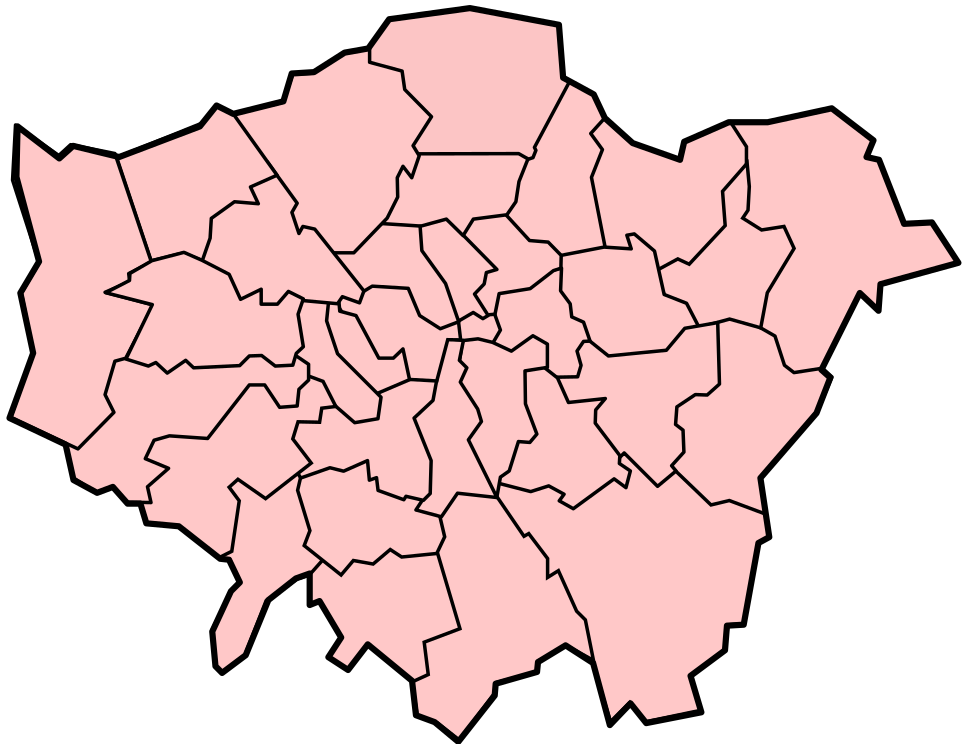
55 kits across seven boroughs
Nearest supplied kitDistance and routing will appear in the app
NEAREST KITREGISTER KITMESSAGESCALL 999
The app
Everything needed to move from panic to a clear next step.
Find the nearest kit, launch sat nav, contact the holder, share the incident location and keep 999 one tap away.
- 01Live kit map
Nearby static and mobile kits with distance and ETA.
- 02Safety-led incident flow
Risk warning first, then location, route and contact.
- 03Responder aftercare
Next-day wellbeing signposting after a traumatic event.
The 2ndChance app is still in development and will be launching soon.
999
Safety stays central
The app supports emergency response. It never replaces it.
Always call 999, follow the call handler's advice under all circumstances and do not enter an unsafe scene. Medical equipment and public guidance should be reviewed by the network's clinical governance lead and the NHS before public release.
Medical evidence, supporting sources and clinical caution +
This website presents general evidence supporting the 2ndChance case. It is not medical advice. Always call 999 and follow the call handler's instructions.
Medical data used on this page
- Gutierrez G, Reines HD, Wulf-Gutierrez ME. Clinical review: Hemorrhagic shock. Critical Care. 2004;8:373–381. Supports average adult blood volume of 7% of body weight or 70 mL/kg. Journal / DOI · PMC1065003.
- Rossaint R, Afshari A, Bouillon B, et al. The European guideline on management of major bleeding and coagulopathy following trauma: sixth edition. Critical Care. 2023;27:80. Table 2 classifies Class IV haemorrhage as >40% blood loss and shows severe physiological compromise and need for a massive transfusion protocol. Journal / DOI · PMC9977110.
- Potente S, Ramsthaler F, Kettner M, Sauer P, Schmidt P. Relative blood loss in forensic medicine—do we need a change in doctrine? International Journal of Legal Medicine. 2020;134:1123–1131. States that Class IV haemorrhage (>40% blood loss) is a preterminal event and, without very aggressive measures, death is expected within minutes. Journal / DOI · PMC7181451.
Additional supporting sources
- DoD STOP THE BLEED — life-threatening bleeding and bystander response.
- American College of Surgeons Stop the Bleed — public bleeding-control education.
- NHS England Ambulance Quality Indicators — ambulance response categories.
- Samaritans and Mind — responder wellbeing support.
Be part of the second chance